

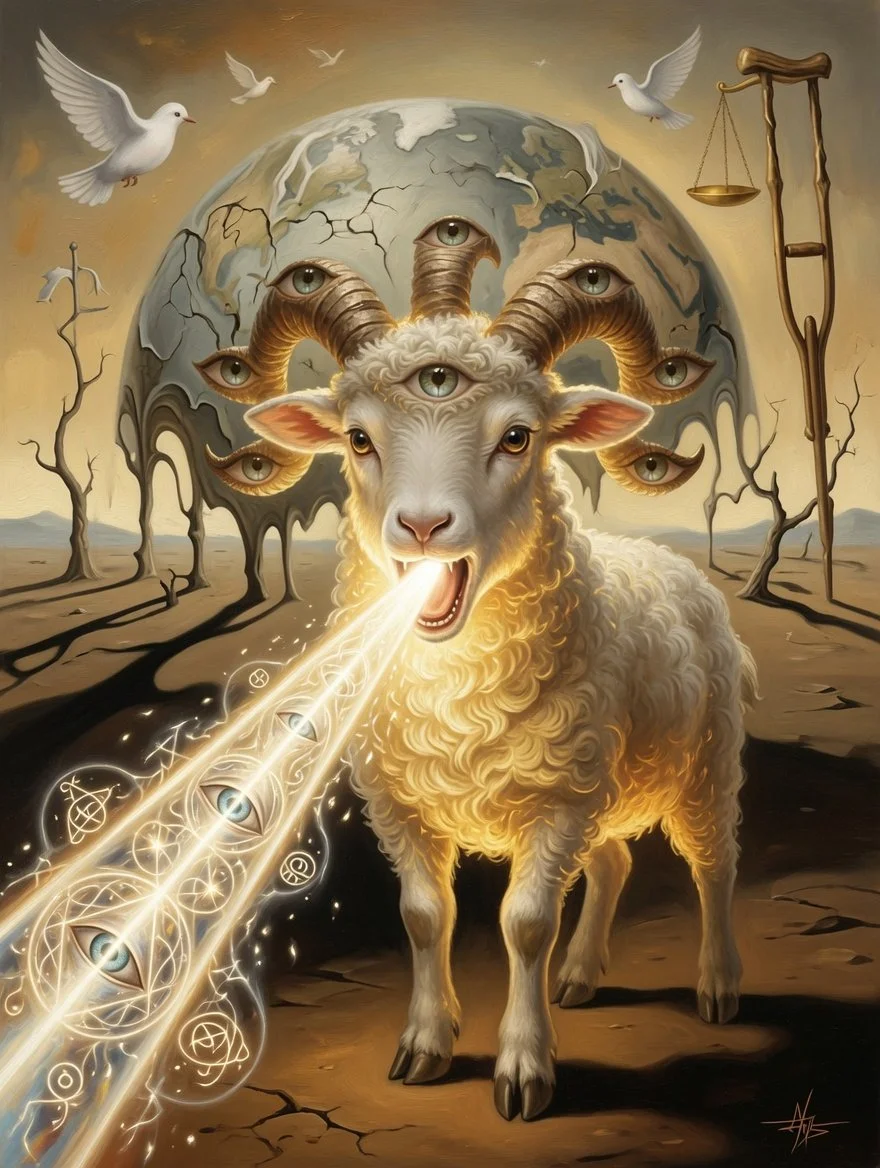
Philosophy of Revelation
The Sanctuary’s Meditation Miracles Sangha will be meeting next on Sunday, July 5th from 3 to 5 PM. After our opening mindfulness meditation, I'll be offering a presentation focused on Chapters 8-10 of the Book of Revelation where we follow the unfolding of God’s Plan for Justice on earth through the seven angels with their seven trumpets. This ongoing class explores the interesting similarities and differences between the non-dualistic teachings of A Course in Miracles and the charged symbolism and escatological drama of the Bible’s most controversial book. See below for links to texts for this upcoming meeting as well as notes from our previous meetings this spring.
Sliding scale donation: $0-$15. All Beings Welcome.
Financial tokens of gratitude, unnecessary but welcome, can be offered through PayPal to info@oursanctuary.org or Venmo to @Justin-Good-26.
Links
Main text: Book of Revelation 8
A Course in Miracles, Chapter 19 “Obstacles to Peace”
Ayo Shosanya, “Study of Revelation: The Fifth Trumpet – Locusts from the Bottomless Pit”
Bart Ehrman, “Is Revelation Describing Warfare in the Twenty-first Century?
Class Notes
May 3rd • “Christian Zionism, Apocalyptic Worldview and Religious Dimensions of the Iranian War”
May 31st • “Three Jesuses: The Lamb, The Lion and the Singularity”
June 14th • “The Lamb’s Wrath, God’s Plan, and the Ego’s Sacrifice”
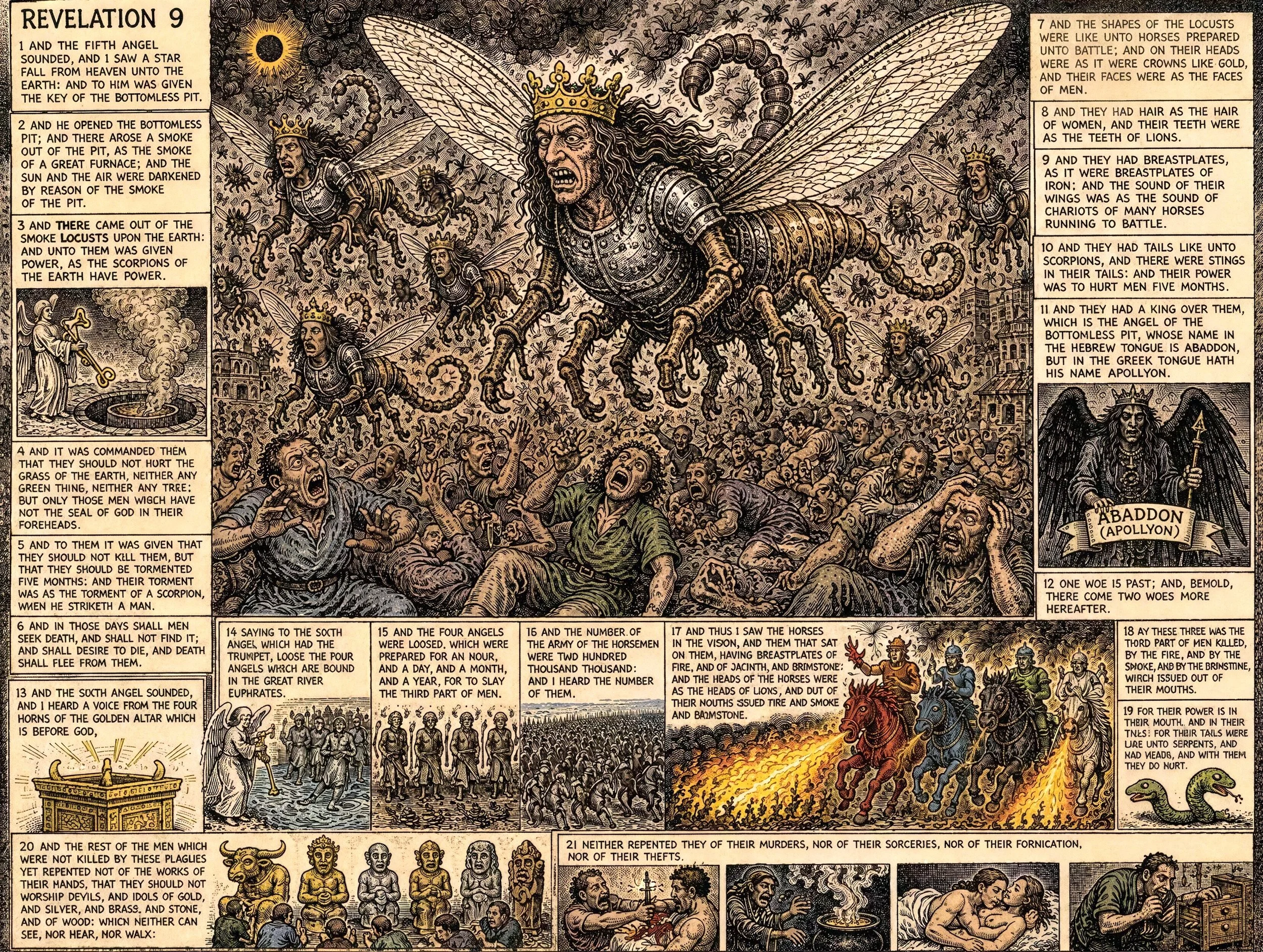
Course Notes
The word "apocalypse" is often understood to mean the end of the world, but it is based on the Greek word Ἀποκάλυψις apokalypsis, meaning "revelation" or "disclosure" of what was previously hidden. Ironically, while used to connote disaster, the original Jewish messianic tradition from which this genre of worldview arises, understood the phenomenon to be hopeful, the ultimate saving disclosure of Truth, Beauty and Justice - of God. As a component of our regular Meditation Miracles Sangha meetings, the Sanctuary will be offering a year long study of the (i.e. phenomenology, epistemology and worldview) of apokalypsis, from The Book of Revelation to UAP Disclosure.
Central to our study will be The Book of Revelation. This mysterious book has occupied the fringes of Christian theology and culture for some time due to its strangeness, symbolic density and moral dualism. Non-Pauline followers of Jesus see the book as mistakenly reflecting the vindictive tribalistic God of the Old Testament, while modern liberal progressive theologians balk at God’s supernatural intervention into physical history. The text is a singular nexus point for theological, historical, technological and metaphysical questions, while interpretations of its end of days narrative influence current US foreign policy towards Israel and elsewhere. As humans face down the triple threats of ecocidal collapse of the biosphere, escalating global war mongering and the advent of Artificial Intelligence, this book helps us think through our assumptions about the nature of reality, history human “civilization” and Divine Purpose. It offers a worldview horrifying realistic in its carnage while uniquely optimistic about the End of History.
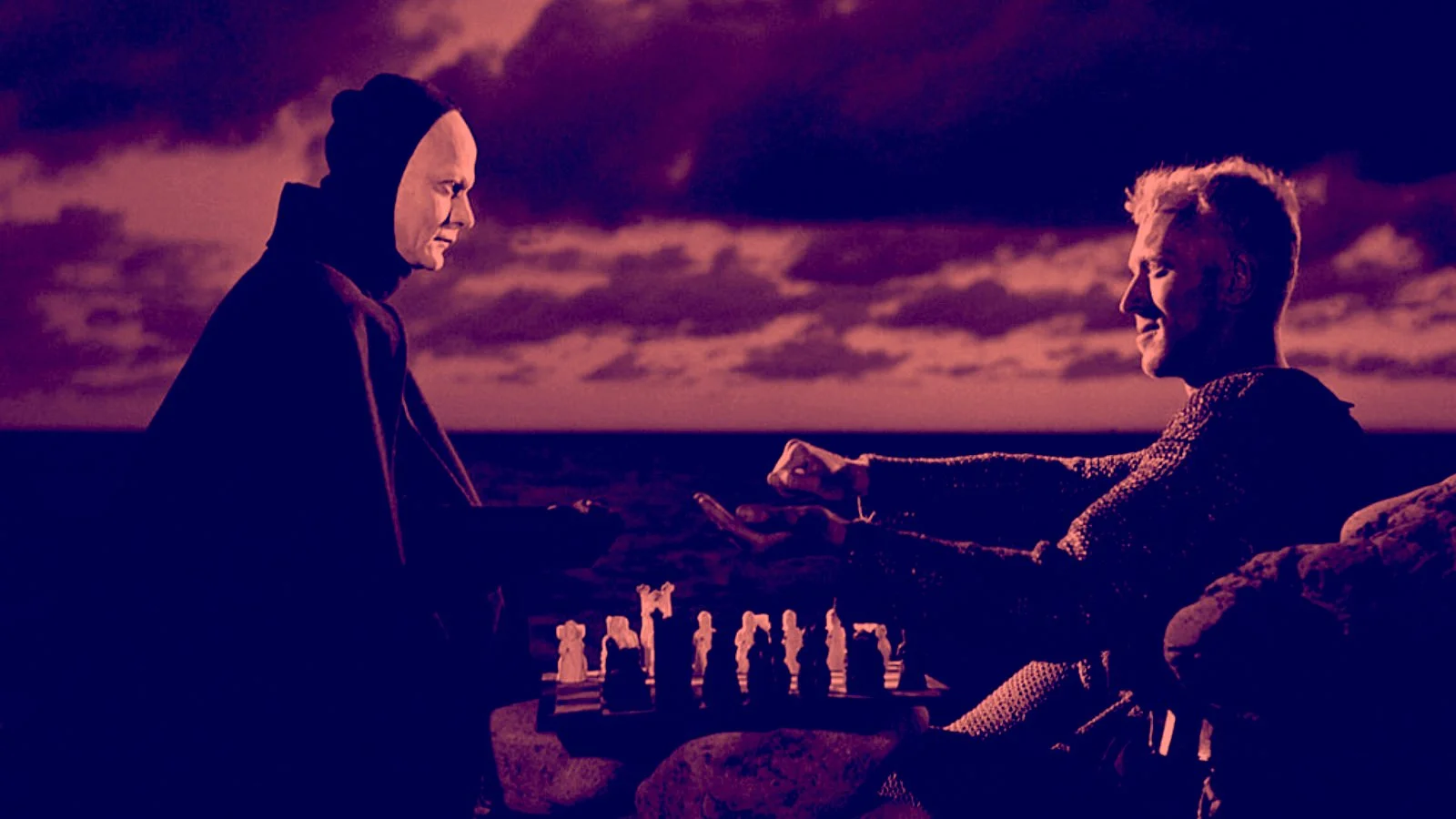
Ingmar Bergman’s The Seventh Seal
Based on a line from Revelation, this is one of my very favorite films. we’ll be screening it when we get to the Seven Scrolls: “When he opened the seventh seal, there was silence in heaven for about half an hour.”
This on-going study will take us into Bible study, history of early Christianity, Jewish apocalyptic theology, Christology, eschatology, and naturally A Course in Miracles, together with reflections on contemporary events such as ecocide, nuclear war and the rise of Artificial Intelligence. We’ll also be looking at contemporary metaphysical views of history and time which reflect in compelling ways the narrative structure of Revelation, specifically the Law of One Ra Material, the work of Dolores Cannon in her book The New Earth and The Three Waves of Volunteers, and the work of Irish mathematician John Lennox.
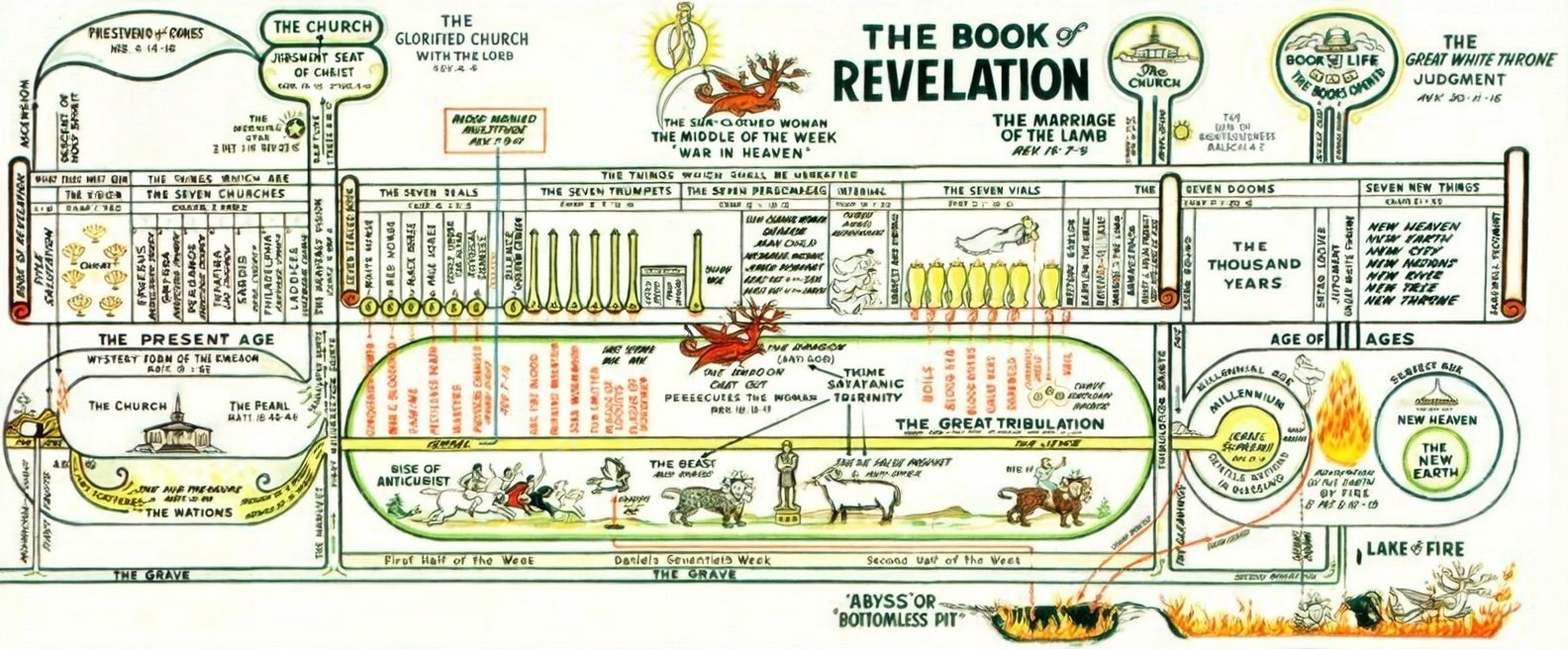
Over the course of 2026, we’ll be dedicating a meeting of Meditation Miracles Sangha to each of the 22 chapters of Revelation, meeting on average two times a month. As usual, these meetings will begin with a 15 min. guided meditation, followed by a check-in before we get into some textual analysis. In addition to the Book of Revelation and A Course in Miracles, I’ll be making use of several commentaries, see below for a list of some of the main resources I’ll be using. As usual, I will provide copies of the texts we will be reading and supplemental notes for each class meeting. All welcome, no prior knowledge required.
Sliding Scale Donation: $0-$25
Bibliography
The Holy Bible, New Living Translation, English Standard Version and King James Version
Michael Gorman, Reading Revelation Responsibly (Cascade Books, 2010).
Steve Gregg, Revelation: Four Views, A Parallell Commentary (Thomas Nelson, 2013).
John Lennox, God, AI & The End of History: Understanding the Book of Revelation in an Age of Intelligent Machines (London: SPCK Group, 2025).
John Lennox, 2084: Artificial Intelligence and the Future of Humanity (Chicago: Zondervan Reflective, 2020).
Carla Rueckert, Living the Law of One (Louisville: L/L Research, 2009).
Dolores Cannon, The New Earth and the Three Waves of Volunteers.
Arthur C. Clarke, Childhood’s End.
Bart Ehrman, “My New View of the Book of Revelation”
Don Samdahl, “Understanding the Book of Revelation”
As noted above, we will be reading the Book of Revelation in dialogue with the Nondualistic & Participatory Escatology of A Course in Miracles. For example, consider Jesus’s answer in the Course to the question, How Will the World End?
1. Can what has no beginning really end? ²The world will end in an illusion, as it began. ³Yet will its ending be an illusion of mercy. ⁴The illusion of forgiveness, complete, excluding no one, limitless in gentleness, will cover it, hiding all evil, concealing all sin and ending guilt forever. ⁵So ends the world that guilt had made, for now it has no purpose and is gone. ⁶The father of illusions is the belief that they have a purpose; that they serve a need or gratify a want. ⁷Perceived as purposeless, they are no longer seen. ⁸Their uselessness is recognized, and they are gone. ⁹How but in this way are all illusions ended? ¹⁰They have been brought to truth, and truth saw them not. ¹¹It merely overlooked the meaningless.
2. Until forgiveness is complete, the world does have a purpose. ²It becomes the home in which forgiveness is born, and where it grows and becomes stronger and more all-embracing. ³Here is it nourished, for here it is needed. ⁴A gentle Savior, born where sin was made and guilt seemed real. ⁵Here is His home, for here there is need of Him indeed. ⁶He brings the ending of the world with Him. ⁷It is His Call God’s teachers answer, turning to Him in silence to receive His Word. ⁸The world will end when all things in it have been rightly judged by His judgment. ⁹The world will end with the benediction of holiness upon it. ¹⁰When not one thought of sin remains, the world is over. ¹¹It will not be destroyed nor attacked nor even touched. ¹²It will merely cease to seem to be.
3. Certainly this seems to be a long, long while away. ²“When not one thought of sin remains” appears to be a long-range goal indeed. ³But time stands still, and waits on the goal of God’s teachers. ⁴Not one thought of sin will remain the instant any one of them accepts Atonement for himself. ⁵It is not easier to forgive one sin than to forgive all of them. ⁶The illusion of orders of difficulty is an obstacle the teacher of God must learn to pass by and leave behind. ⁷One sin perfectly forgiven by one teacher of God can make salvation complete. ⁸Can you understand this? ⁹No; it is meaningless to anyone here. ¹⁰Yet it is the final lesson in which unity is restored. ¹¹It goes against all the thinking of the world, but so does Heaven.
4. The world will end when its thought system has been completely reversed. ²Until then, bits and pieces of its thinking will still seem sensible. ³The final lesson, which brings the ending of the world, cannot be grasped by those not yet prepared to leave the world and go beyond its tiny reach. ⁴What, then, is the function of the teacher of God in this concluding lesson? ⁵He need merely learn how to approach it; to be willing to go in its direction. ⁶He need merely trust that, if God’s Voice tells him it is a lesson he can learn, he can learn it. ⁷He does not judge it either as hard or easy. ⁸His Teacher points to it, and he trusts that He will show him how to learn it.
5. The world will end in joy, because it is a place of sorrow. ²When joy has come, the purpose of the world has gone. ³The world will end in peace, because it is a place of war. ⁴When peace has come, what is the purpose of the world? ⁵The world will end in laughter, because it is a place of tears. ⁶Where there is laughter, who can longer weep? ⁷And only complete forgiveness brings all this to bless the world. ⁸In blessing it departs, for it will not end as it began. ⁹To turn hell into Heaven is the function of God’s teachers, for what they teach are lessons in which Heaven is reflected. ¹⁰And now sit down in true humility, and realize that all God would have you do you can do. ¹¹Do not be arrogant and say you cannot learn His Own curriculum. ¹²His Word says otherwise. ¹³His Will be done. ¹⁴It cannot be otherwise. ¹⁵And be you thankful it is so.

Meditation Miracles Sangha Facilitator
Justin Good serves with his wife Jen Taylor as Co-Executive Directors of The Sanctuary. He teaches Philosophy at Middlesex Community College, Ethics of Technology at Central CT State University and Ethics at York Correctional Institute in Niantic. Pictured here with his beloved dog Tristan, Justin is a follower of Diogenes the Mystic whose philosophy centered on the goodness of dogs.